

Architects of the Everyday and SA’s Infrastructure Iceberg
South Africa has the capital to invest in infrastructure. The challenge is getting it into the projects people experience every day.
Many asset managers who invest in South African infrastructure will have heard some version of the same complaint from a pension fund's executive principal officer: “You invest our members' contributions in infrastructure, yet they still live with potholes, load-shedding and broken taps. We hear about ports, pipelines and transmission lines, but where is the investment in the infrastructure they actually use every day?”
It is a fair question. Infrastructure investment has historically focused on the large national assets that members rarely see, while institutional capital has struggled to reach the infrastructure closer to home. For a sector that aspires to help build a more inclusive economy, that is a significant blind spot. Inclusive asset allocation starts with seeing the whole infrastructure landscape and then deciding where member capital can play the most appropriate role.
The Infrastructure Iceberg
Think of South Africa’s infrastructure as an iceberg with three layers. The visible tip is Home: the roads, water, electricity, sanitation and connectivity people use every day. Just below the waterline sits Community, which includes municipal networks, clinics, schools, waste facilities and transport nodes. At the unseen base of the iceberg is National: the transmission grids, ports, bulk water, rail and digital networks that support everything above them.

Pension funds, quite correctly, invest heavily in the National layer because large infrastructure projects can provide steady, predictable returns over decades, which suits the long-term nature of pension savings. Yet these are also the assets members are least likely to see, making much of the infrastructure that their savings fund largely invisible to them. This creates a disconnect in appreciation and benefits from infrastructure investment. Better explaining these layers can help bridge that disconnect, but the bigger challenge is finding ways for private capital to reach the Community layer.
Matching Capital to its Iceberg Layer
Inclusive asset allocation means recognising that each layer requires different funding, with pension capital entering only where the structure and risk are appropriate.
The Home layer should generally not carry direct pension-fund risk. Private capital can still play a role through vendor, retail and bank financing for home solar, Wi-Fi, gas heating and cooking, and demand-management systems. This will require a cultural shift towards metered consumption, which improves revenue collection and makes external funding more viable. The resulting consumption data can also help target household support where it is needed. The challenge is expanding this funding without further pressuring already stretched household incomes.
The National layer remains the natural home for the bulk of pension capital. Regulation 28 permits allocations of up to 45% to infrastructure, ticket sizes of R500 million to R10 billion suit institutional minimums, and the DoEE-NT Renewable Energy Independent Power Producer Procurement Programme has shown what a credible, de-risked pipeline can mobilise: well over R250 billion across more than 120 projects nationwide.
The Community layer is where things get more complicated. This is where people most directly experience service delivery, yet private capital has historically struggled to reach it. One reason is scale. A single community project may be too small for a large institutional investor, but pooling projects, demand and revenue can create an investment large enough to attract capital. It also gives communities more bargaining power with vendors. Unlocking this layer therefore requires a blend of different sources of capital to work together.
Blended Finance as the Bridge to the Middle
Blended finance can make selected Community-layer projects suitable for pension capital without exposing members to unnecessary risk. It does this by combining different types of capital, with concessional funding absorbing the first losses and providing a layer of protection for commercial investors.
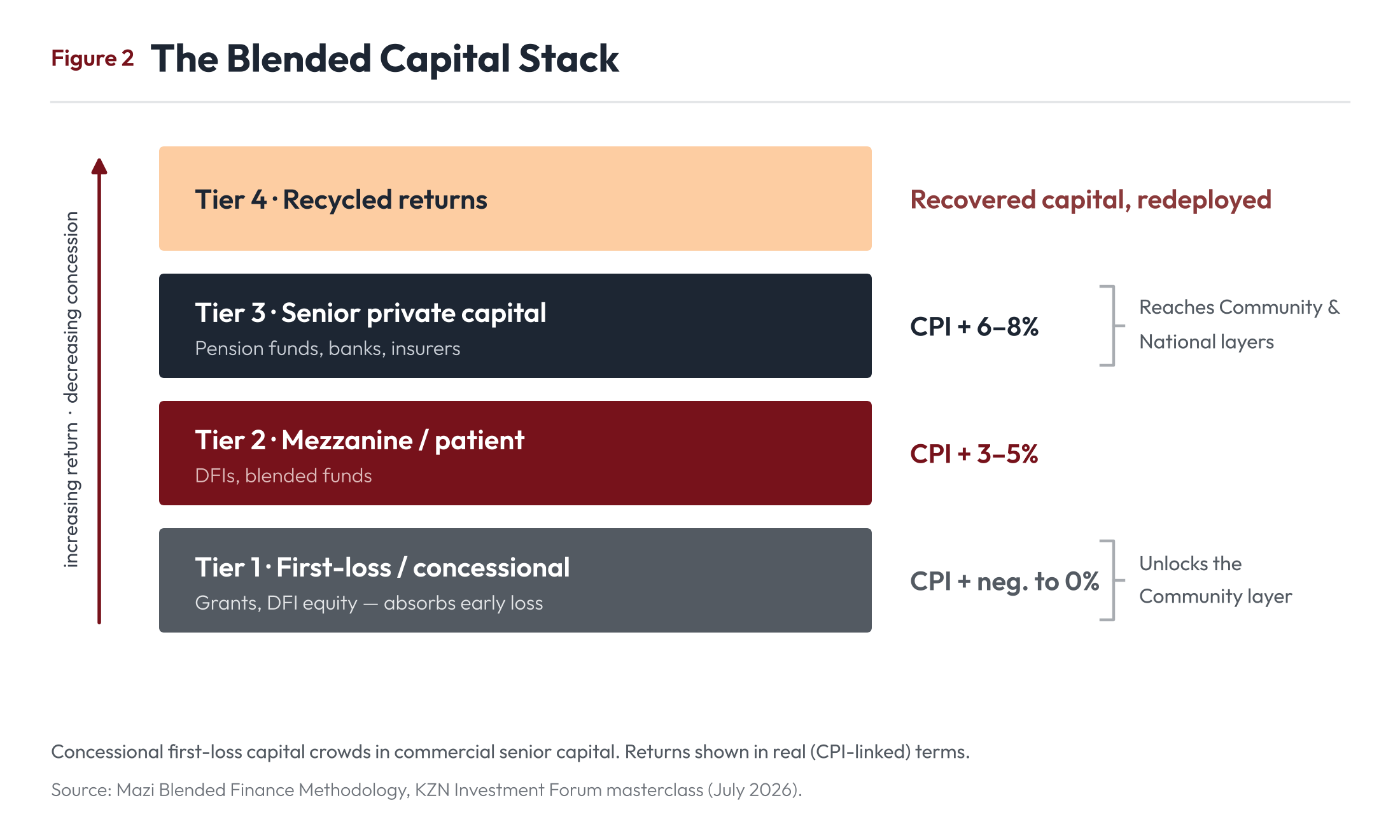
At the base, grants or development-finance equity absorb early losses. Above that sits patient or mezzanine capital from development finance institutions, followed by senior private capital from pension funds, insurers and banks. Each layer helps protect the commercial capital above it.
Five design principles make the structure sound: a genuinely loss-absorbing first-loss layer; independent governance; concessional funding that is released only once private capital commits at agreed ratios; pooled community demand with ring-fenced revenue collection; and outcome-based reporting that measures service delivery alongside financial returns.
This is already happening. The National Treasury-initiated Infrastructure Fund, now under the Department of Public Works and Infrastructure (DPWI), has approved close to R38 billion across a dozen blended-finance projects, most of them at the Community layer. In KwaZulu-Natal, similar structures are being used across water reuse, logistics and student housing, with projects ranging from R600 million to R1.2 billion. Each follows the same pattern: development-finance first-loss, private senior capital, ring-fenced off-take and service-delivery targets alongside financial returns.
South Africa Needs Investable Projects
Institutional investors have both the capital and the regulatory headroom to invest more in infrastructure. The constraint is a shortage of bankable, well-governed projects at the scale and structure pension funds require. Ask any large local manager and the answer is the same: everyone is competing for the same short list of credible opportunities.
That creates an opportunity for a new generation of infrastructure managers, including black-owned and majority-black managers. As the market develops, the ability to originate, structure and govern blended-finance deals becomes increasingly valuable. These capabilities can be built and do not depend on having the largest balance sheet. Managers who can bring together first-loss capital, secure ring-fenced revenue and establish effective governance at community level can compete through expertise and execution rather than legacy scale.
Changing the Due-Diligence Question
The policy environment is also shifting towards the Community layer. Following its July 2026 intervention in defaulting municipalities, National Treasury reported signed payment agreements and billions in arrears flowing to creditors, including water boards. It has since signalled a R54 billion Metro Trading Services Reform to move municipal water and electricity towards ring-fenced utility models, continued the R2.3 billion smart-meter grant programme, and proposed new public-private partnership regulations for local government. Together, these measures could help make Community-layer infrastructure investable at greater scale.
For pension fund trustees and executive principal officers, this changes the due-diligence conversation. The traditional question has been: "What is your IRR?" That remains important, but Community-layer investment requires another: "Show us your Community-layer funding structure and how it can work sustainably.” A manager who can answer that, with a proprietary pipeline, genuine first-loss protection, independent governance and outcome measurement alongside the IRR, is a manager helping to build the inclusive economy in practice, not just in theory.
Architects of the Everyday
A more inclusive economy requires capital to deliver competitive, risk-adjusted returns while reaching the infrastructure people use every day. The Community layer offers that opportunity, with blended finance helping to make these projects investable for pension capital. When members ask why they cannot see the infrastructure their savings are funding, they are asking the industry to become architects of the everyday. Asset allocation is where that journey begins.


