

From ESG to sustainability: How South African REITs Turned Crisis into Competitive Advantage
Renewable energy and water security have become essential infrastructure for protecting income and asset values in SA.
Few sectors have had to reinvent themselves as dramatically as South African listed property over the past decade. Between 2016 and 2026, the country's real estate investment trusts (REITs) faced a convergence of structural challenges. Eskom's rolling load shedding, deteriorating municipal water infrastructure, double-digit electricity tariff increases, rising municipal rates and escalating environmental expectations fundamentally changed the economics of owning and operating commercial property.
What began as an ESG reporting exercise has evolved into a core operational and capital allocation strategy for the sector. Sustainability is no longer primarily about reducing carbon emissions or meeting investors' ESG expectations. It now plays a central role in protecting income streams, maintaining occupancy, improving operating margins and preserving asset values.
The South African listed property sector has effectively become its own utility provider. REITs are increasingly generating electricity on-site, procuring renewable energy through private power purchase agreements (PPAs), investing in battery energy storage systems (BESS), harvesting and recycling water, and deploying intelligent building technologies to optimise resource consumption. These initiatives are not only reducing carbon emissions, but also enhancing distributable earnings and improving long-term shareholder returns.
Crisis Became the Catalyst
Perhaps the greatest irony is that South Africa's infrastructure crisis did more to accelerate innovation than regulation or investor pressure ever could.
At the height of load shedding between March 2022 and June 2023, solar PV adoption across South Africa's built environment increased by more than 300%. Property owners quickly realised that diesel generators, once considered the default backup solution, were neither financially nor environmentally sustainable. Rising diesel prices, escalating maintenance costs, noise pollution and significant carbon emissions made them an increasingly unattractive long-term option.
Renewables Take Centre Stage
Initially, many landlords viewed rooftop solar primarily as insurance against power interruptions. As the market matured, however, the investment case became increasingly compelling. Equipment costs fell, installer competition intensified, financing options improved and electricity tariffs continued to rise well above inflation. Consequently, renewable energy projects gradually evolved from defensive capital expenditure into yield-enhancing investments.
Today, many REITs view solar infrastructure like any other value-accretive capital project. It generates attractive internal rates of return while simultaneously increasing property valuations.
From Backup to Business Strategy
One of the biggest misconceptions during the early years of load shedding was that rooftop solar automatically ensured uninterrupted power. In reality, grid-tied solar systems shut down whenever the national grid fails unless supported by battery energy storage systems (BESS) or a diesel generator. This technical limitation accelerated investment beyond solar panels.
The sector has shifted towards integrated energy systems that combine rooftop solar, BESS, wheeled renewables and sophisticated energy management software. Rather than reducing electricity consumption alone, these systems allow buildings to optimise energy procurement in real time while reducing reliance on Eskom during periods of peak demand.
As South Africa gradually liberalises its electricity market, buildings are expected to source electricity from a wider range of providers, marking a significant shift away from traditional municipal supply towards decentralised energy procurement.
When Sustainability Starts Paying
The business case for renewable energy has strengthened considerably over the past decade. While sustainability was initially driven by ESG reporting frameworks and carbon reduction commitments, investment decisions are increasingly driven by financial returns. Falling equipment costs, rising electricity tariffs and growing operational certainty have shortened payback periods and improved project economics.
Sustainability investments now contribute directly to earnings growth. Lower electricity costs improve net operating income, while reliable power enhances tenant satisfaction, reduces vacancies and supports rental reversions. Together, these benefits translate into higher distributable income and improved property valuations. The industry's focus has shifted from regulatory compliance towards resilience, efficiency and long-term cash flow optimisation.
Water Joins the Equation
Electricity security has dominated headlines, but water resilience has quietly become an equally important investment theme. Following Cape Town's "Day Zero" crisis and continued deterioration of municipal infrastructure, REITs have accelerated investment into boreholes, rainwater harvesting, greywater recycling and intelligent leak detection.
Water security is increasingly viewed as essential business continuity infrastructure. For shopping centres, logistics facilities and office parks, a reliable water supply is critical to maintaining operations, supporting tenants and protecting rental income.
Combined with energy investments, these initiatives are creating more resilient buildings that are less dependent on municipal infrastructure.
Growthpoint and Resilient Lead the Way
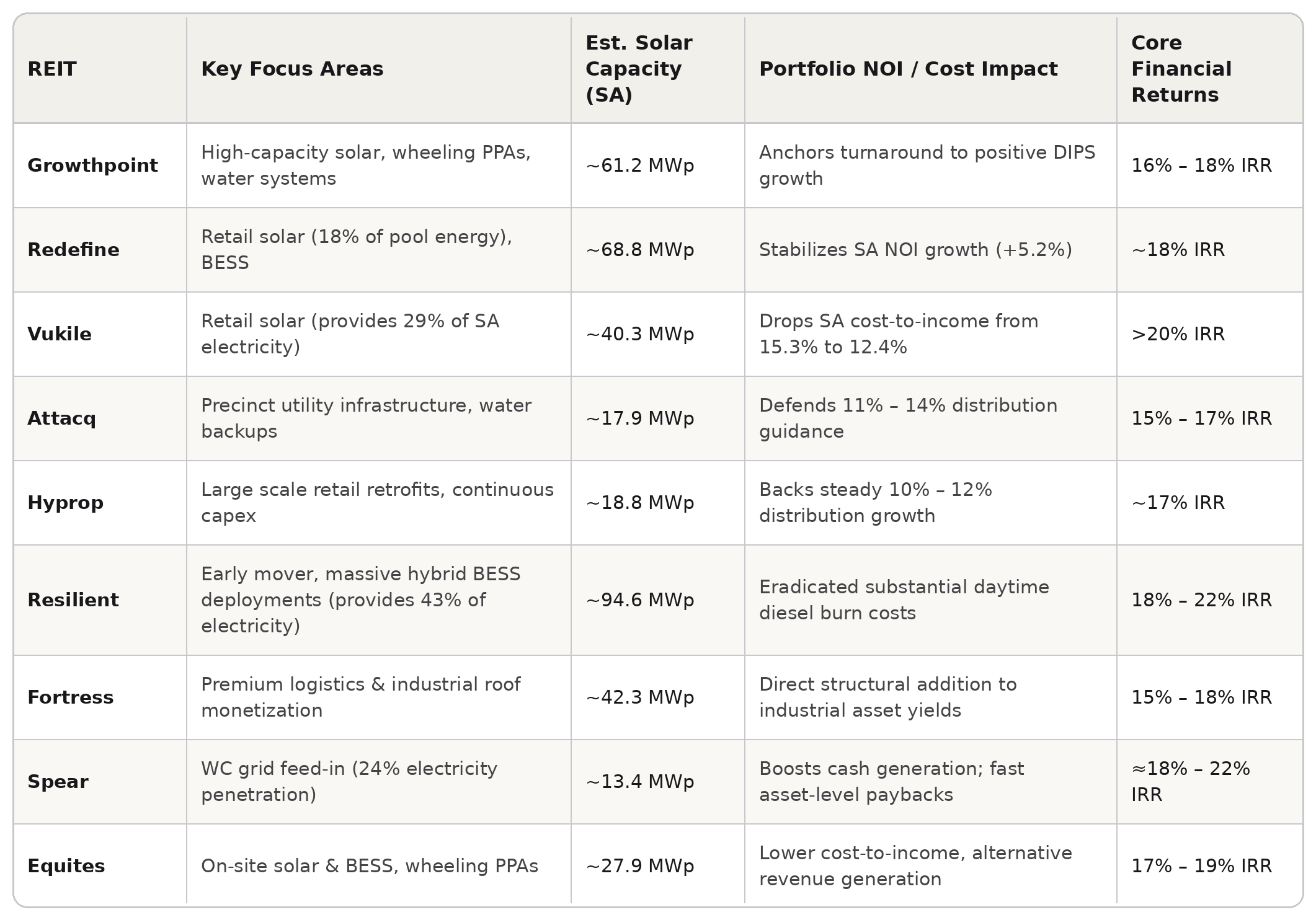
Growthpoint has emerged as a leader in renewable energy adoption within the domestic listed property sector, demonstrating how sustainability can drive operational resilience and long-term shareholder value. Since introducing its first rooftop solar installation in 2011, the company has expanded its energy strategy from embedded generation into a diversified renewable energy platform that includes on-site solar, hydroelectric generation and wheeled renewable electricity.
By the end of financial year 2025, Growthpoint had exceeded its original target of 50 MWp of installed solar capacity, reaching more than 68 MWp across 83 rooftop solar plants after investing more than R1 billion. The company has also expanded into off-site renewable generation through its partnership with Etana Energy. This includes a 195 GWh pa PPA, underpinned by a 30% equity stake in the Boston Hydroelectric Plant. Future supply will also include renewable electricity from the Zen and Bergrivier wind farms. Together, these initiatives are expected to meet approximately 40% of Growthpoint's total electricity demand.
Resilient REIT has adopted a pragmatic sustainability strategy centred on protecting retail trading performance and preserving long-term cash flows. Over the past decade, it has expanded its solar footprint to 88.0 MWp, with projects under way set to increase capacity to 94.4 MWp by the close of the 2026 financial year. Solar already supplies 43.2% of the company's electricity requirements. Resilient has also expanded investment in BESS, with 30.7 MWh of active storage capacity helping centres maximise solar utilisation, reduce diesel dependence and improve energy reliability during periods of electricity disruption.
Water resilience has become another key component of the company's capital allocation strategy. Investments in boreholes, rainwater harvesting, on-site storage and water-efficient technologies have reduced reliance on municipal infrastructure while helping ensure uninterrupted trading for tenants and customers alike.
Following the Leaders
Growthpoint and Resilient are not alone. Renewable energy and water resilience have become capital allocation priorities across the listed property sector.
Redefine has continued expanding rooftop solar, water harvesting and energy optimisation while embedding climate considerations into its investment decisions. Vukile has integrated renewable energy, climate resilience and green financing across its South African and Spanish portfolios, linking sustainability directly to long-term earnings growth.
Hyprop has invested extensively in solar generation across its shopping centre portfolio, reducing operating costs while ensuring uninterrupted trading during electricity disruptions. Meanwhile, Attacq has embedded sustainability into Waterfall City's smart-city framework through district energy systems, renewable generation and advanced utilities management.
Equites, Fortress and Burstone have integrated renewable energy into their logistics developments, reflecting growing tenant demand for energy-efficient facilities that reduce operating costs.
Collectively, these investments show how sustainability has become an integral part of portfolio management, capital allocation and long-term value creation.
Challenges Remain
Despite the progress made, several structural barriers continue to constrain renewable energy deployment. While solar panel prices have fallen significantly over the past decade, BESS remain relatively expensive, extending investment payback periods despite recent cost declines.
Physical constraints also remain. Many office buildings lack sufficient rooftop area to generate all their electricity requirements, necessitating complementary solutions such as wheeled renewable energy or solar carports.
Perhaps the greatest obstacle, however, remains regulation. Approval processes for small-scale embedded generation frequently take longer than project construction itself. Municipal permitting requirements remain inconsistent, while regulatory duplication continues to increase installation costs and delay implementation. Although reforms are gradually improving the environment, administrative bottlenecks continue to slow the pace of renewable energy investment.
Looking Ahead
The evolution of sustainability within South African listed property is one of the clearest examples of crisis-driven innovation. What began as an ESG obligation has evolved into a core driver of operational performance, resilience and shareholder value creation.
Buildings capable of delivering reliable electricity and water increasingly command stronger occupancy, lower operating costs and higher asset valuations. Investors are beginning to differentiate between resilient buildings and infrastructure-dependent assets, while tenants increasingly view reliable (renewable) energy and water as essential infrastructure.
The next phase is likely to extend beyond rooftop solar, with integrated energy ecosystems combining solar PV, BESS, hydroelectric generation, wind power, wheeled electricity, AI-driven energy optimisation and more sophisticated carbon management.
For South African REITs, sustainability has become a competitive advantage. It protects cash flows, strengthens earnings resilience and positions property portfolios for a lower-carbon, infrastructure-constrained future.
The next decade is unlikely to be defined by who owns the most property, but by who owns the most resilient property.


