

When Markets Turn Noisy, Discipline Wins
The headlines change daily. The rules of long-term investing do not.
The first quarter of 2026 started with a surge of geopolitical shocks. From escalating conflict in the Middle East to renewed global tensions, headlines have been relentless. That environment naturally pushes investors toward caution. The instinct is to step back, wait for clarity, and avoid volatility. But history rarely rewards that approach.
The biggest risk to long-term returns is not volatility itself, it is stepping out of the market at the wrong time. In early January, U.S. forces captured Venezuelan President Nicolás Maduro and his wife, Cilia Flores. By late February, tensions escalated sharply in the Middle East. The U.S., alongside Israel, carried out coordinated airstrikes and intelligence-led operations on Iran, resulting in the killing of Supreme Leader Ali Khamenei and several senior officials in Tehran. Iran responded with missile and drone attacks targeting Israel, U.S. bases in the Gulf, and key energy infrastructure. What began as targeted strikes has since escalated into a full-blown and ongoing war.
The key question in our minds is how long this conflict will last. If it drags on for months, the risk of a global recession rises, which would be the most damaging outcome for economies and markets. History offers a clear pattern: conflicts tend to last longer than initially expected.
The Russia-Ukraine conflict began with the annexation of Crimea in 2014 and escalated into a full-scale invasion in February 2022. As of March 2026, that war is now entering its fifth year at full scale. The Israel-Hamas war, which began in October 2023, has also extended beyond initial expectations and is now more than two years in.
With macro uncertainty rising, the natural human instinct is to react, to seek the safety of the sidelines and focus on the immediate horizon. As the custodians of your capital, our responsibility is to provide a different perspective: one that distinguishes the signal from the noise. In a world dominated by breaking news alerts and shifting narratives, it is easy to lose sight of the fundamentals. Short-term volatility is often the price of long-term returns. While the headlines focus on conflict, we remain focused on the underlying health of our portfolio companies, their cash flows, and their ability to innovate through structural shifts.
We believe that true value is built on fundamental facts, not short-term sentiment.
The Power of "Time in the Market"
History and data consistently teach us that the greatest enemy of wealth creation is trying to time the market. The UBS Global Investment Returns Yearbook 2026, which tracks long-term returns for equities, bonds, cash, and gold across more than 35 global markets, reinforces this.
Over time, diversified assets have delivered returns that far outweigh the short-term noise of geopolitical crises.
The real driver of those returns is compounding, and compounding demands time. Stepping in and out of markets disrupts that process.
That is not to say that we ignore the global environment; rather, we navigate it with a long-term lens. Deglobalisation presents risks, but it also creates opportunities for new industrial efficiencies and domestic innovations that will drive the next decade of growth.
We encourage you to stay disciplined. It is time in the market, rather than timing the market, that creates lasting legacy wealth.
Graph 1 below shows real annual equity returns over 125 years, highlighting the power of compounding. South Africa consistently ranks among the top performers, despite the political risks and crises it has faced.
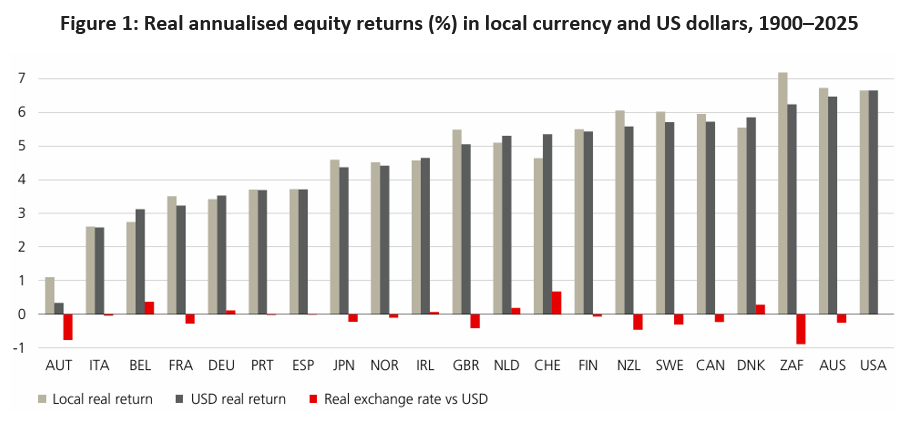
Ultimately, long-term wealth is built by staying invested in well-diversified portfolios, not by reacting to short-term noise. Volatility is inevitable, but it is the investors who stay disciplined through it who benefit most from compounding and sustained market growth over time.


